Paloma's Picassos
It seems fitting that Picasso Tête-à-tête—the first collaboration with the youngest of the artist’s four children, Paloma Picasso—would be the last exhibition held in Gagosian Gallery’s 980 Madison Avenue venue in New York. Quirky, personal, and illuminating, the exhibition occurs following a series of well-received and tightly focused Picasso exhibitions organized for Gagosian by the late art historian, and the artist’s friend, biographer, and confidant, John Richardson (1924–2019), including Mosqueteros (2009); Picasso—The Mediterranean Years (1945-1962) (2010); Picasso and Marie-Thérèse: L’amour fou (2011), which Richardson co-curated with the artist’s granddaughter Diana Widmaier Picasso; and Minotaurs and Matadors (2017), curated by Richardson in partnership with Bernard Ruiz-Picasso, the artist’s grandson. The catalogue for Picasso Tête-à-tête had yet to be published at the time of this writing, but the show coincides with an array of recent Picasso books. Of prominent note among them are Looking at Picasso (2023) by critic Pepe Karmel, providing a twenty-first-century reassessment of the artist’s work, and this year’s Picasso/Asia by Doryun Chong and François Dareau, exploring the complex relationship between contemporary Asian artists and Picasso’s legacy (both Thames & Hudson).
Picasso Tête-à-tête adheres to Richardson’s biographical approach, with a mix of famous works and rarely exhibited pieces spanning seventy years. Many of these, created between 1896–1972, are borrowed from the artist’s estate and from Paloma’s personal collection, and some have never before been publicly shown. A renowned jewelry designer, Paloma clearly has an eye for effective display. The approximately fifty works featured here are not arranged chronologically, and some arresting juxtapositions generate considerable excitement throughout the gallery’s two floors. One sculpture arrangement, for instance, has Picasso’s seminal bronze Tête de Femme (Fernande) (1909), placed beside his colorful ceramic Tête de Femme bleu (1948–49). The four-decade span between these two works encapsulates momentous shifts, not only stylistically, but historically and culturally. Created in Paris, the angst-ridden, fractured proto-Cubist portrait of Picasso’s first muse, Fernande Olivier, yields to the whimsical terra-cotta portrait of his post-war partner, the artist Françoise Gilot, Paloma’s mother, made the year Paloma was born on the Côte d’Azur.
By focusing on mostly youthful faces and heads, themes of innocence or the point of view of a child are often evoked in the exhibition. Paloma’s memories of her father, and watching him work in the studio, stem only from years prior to 1964. That year, Gilot published a scathing account of her years with Picasso, in her autobiographical Life with Picasso, which so upset the artist that he severed contact with Gilot as well as with Paloma and her brother Claude. Among the most curious and emotionally wrenching objects on view are a series of small dolls that Picasso made for Paloma to play with in 1952. These seven schematic figures, all titled Poupée Paloma, made of carved and painted wood, string, and wool, have blocky, geometricized bodies but delicately rendered faces that approximate the three-year-old Paloma’s features.
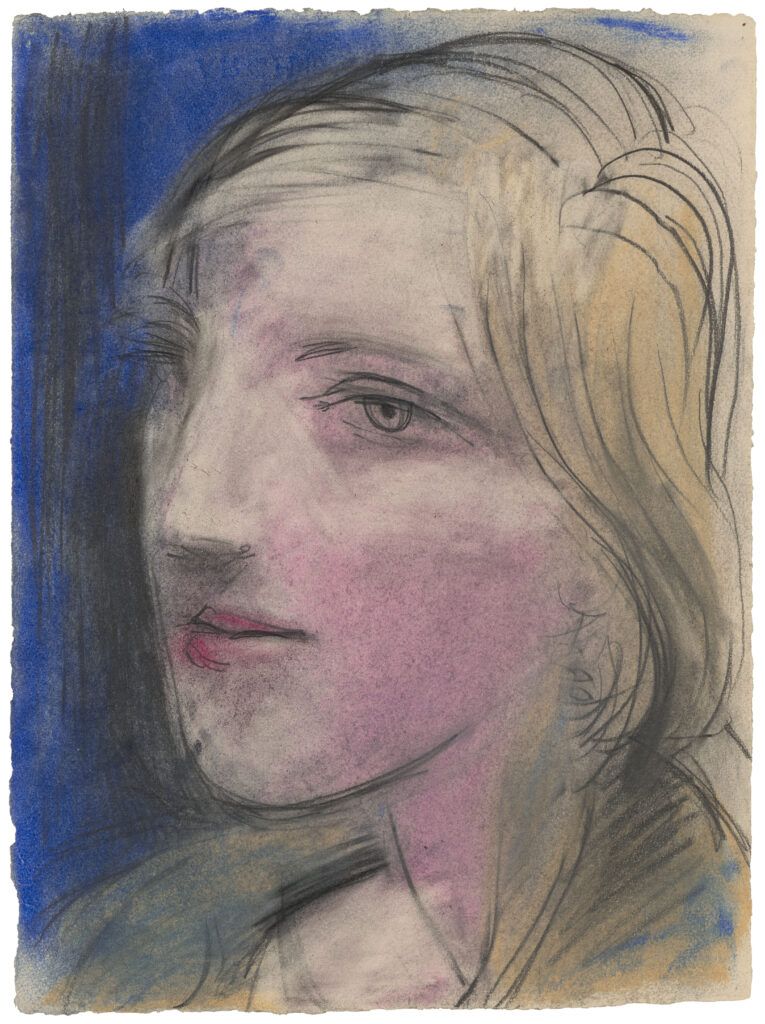
Predating Paloma’s time with her father, some key earlier works underscore Picasso’s virtuoso skill as a portraitist, including a realist self-portrait drawing made in Spain in 1897, when the artist was barely sixteen. A similarly consummate work, the delicately rendered pastel Portrait de femme (Marie-Thérèse) (1936) conveys the radiant youthful beauty of the artist’s 1930s muse. As World War II approached, it became clear that Picasso viewed the human face, metaphorically at least, as a rather terrible place. Extremely expressionistic works here, such as Portrait de femme au béret rouge (1937), and Tête de femme (Dora Maar) (1941), with their dark, slashing lines, and garish colors, reflect the pain and human suffering of the war years.
A generous number of late works from the 1960s and early ’70s, including Le baiser II (1969) created just a few years before the artist’s death in 1973, exude the raw sensuality, if not sexuality, that the artist had always explored in the human form. By contrast, even among his last works, Picasso could deliver images of subtlety and understatement. Since Paloma was named by her parents after the dove of peace, one of the most gentle and sweet images on view from the last years, Tête (1971), shows the head of a small child, rendered with feathery brushstrokes, kissing a small bird—perhaps a little paloma.
Picasso Tête-à-tête in collaboration with Paloma Picasso at Gagosian Gallery, 980 Madison Avenue, NY from April 18 to July 3, 2025.